
A new Road Safety Strategy aimed at cutting deaths and serious injuries on Britain’s roads is facing criticism from frontline policing voices who warn that without proper enforcement and investment, it’s ‘not worth the paper it’s written on’.
Northumbria Police Federation’s roads policing lead, Russ Blenkinsop, says that the revised strategy signals a positive shift in prioritising road safety and reducing harm, but it risks falling short unless ambition is matched by adequate frontline resourcing.
Russ, who has spent almost three decades in policing – including 24 years in roads policing with 14 of those as a forensic collision investigator, says road deaths have become dangerously normalised.
In Northumbria alone, 39 people were killed on the roads last year, 48 in 2024 and three have already died this year.
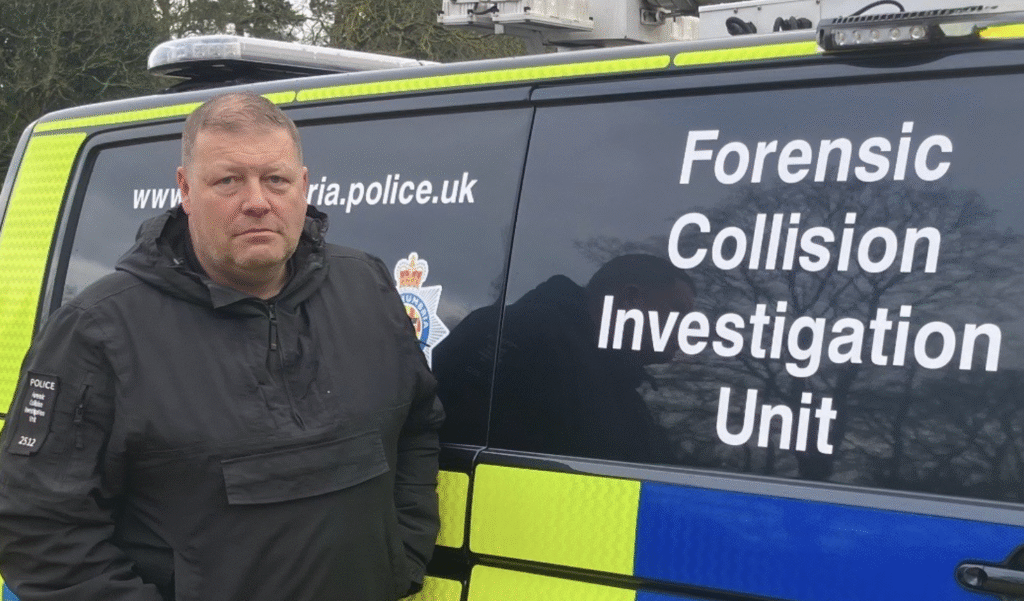
Northumbria Police Federation’s roads policing lead, Russ Blenkinsop
Russ said: “Behind each statistic is a family devastated, a community changed, and emergency responders left carrying the trauma long after the roads reopen.
“Sadly, though, society is starting to accept this level of loss because it happens so often.
“And worse, people think it will never happen to them. But it does – and when it does, the impact is absolute.”
Road Safety Strategy
The new Road Safety Strategy sets an ambitious target to achieve a 65 per cent reduction in road deaths and serious injuries by 2035.
Built around a ‘Safe System’ approach, the plan acknowledges that human error is inevitable but seeks to prevent fatalities through coordinated improvements to vehicles, infrastructure, and road user behaviour.
Key proposals include mandatory eye tests for older drivers, extended learning periods for new drivers, lower drink-driving limits for novices, and tougher enforcement measures, such as vehicle tracking with ‘ghost’ plates.
“The new strategy speaks confidently about safety outcomes, but requires an enforcement capacity that no longer exists,” continued Russ.
“Road policing has been steadily stripped back over the years, with fewer specialist officers, reduced visibility and eroded capability – even as expectations and demand continue to grow.
“Ultimately, you can have the biggest and best road safety strategy in the world, but if you haven’t got anyone to enforce it, it’s meaningless.”
Copped Enough
That concern sits at the heart of the Federation’s Copped Enough campaign, which highlights the growing gap between what police are asked to deliver and the resources they are given to do it.
Officers are repeatedly tasked with doing more with less – and then blamed when outcomes do not improve.
And Russ said that policing – and society – are not only becoming more reliant on technology, but using digital devices to replace humans, which could create new risks.
“Cameras cannot breathalyse drivers, stop vehicles that are fleeing, or deal with drug-impaired motorists,” he explained.
“And drugs are becoming a massive problem on the roads. A camera isn’t going to stop someone who’s high or drunk. Only a real officer can do that.”
He added that visible traffic officers also act as a deterrent in ways technology never can.
He said: “If an actual traffic cop is behind you, people change their driving behaviour – even if it’s just to stop and talk.”
Drink-drive limits
The strategy’s proposals around lowering drink-drive limits have also raised concerns. While well-intentioned, Russ warned that without increased enforcement capacity, such changes could unintentionally push more drivers to flee rather than stop, escalating danger for everyone.
“People who drink-drive are often already well over the limit,” Russ said. “Without enforcement, lowering the limit won’t change behaviour, it may just make things more dangerous.”
For roads policing officers, like Russ, the consequences are deeply personal. He recalled a 2015 incident involving a young child struck by a bus, a case that still haunts him.
“I went home, my kids were in bed, and I just cried,” he said. “You never forget certain jobs. There will always be one that stays with you.
“The trauma is horrific. You get used to things you shouldn’t ever have to get used to.”
Russ ended: “Without ongoing funding for more resources, advanced training, and up-to-date equipment, the strategy may set goals that frontline officers are simply unable to achieve in practice.
“In reality, this may add even more pressure on officers who are already operating under intense strain.”
READ MORE: Police Reform – Branch chair says ‘engagement with members is vital.